
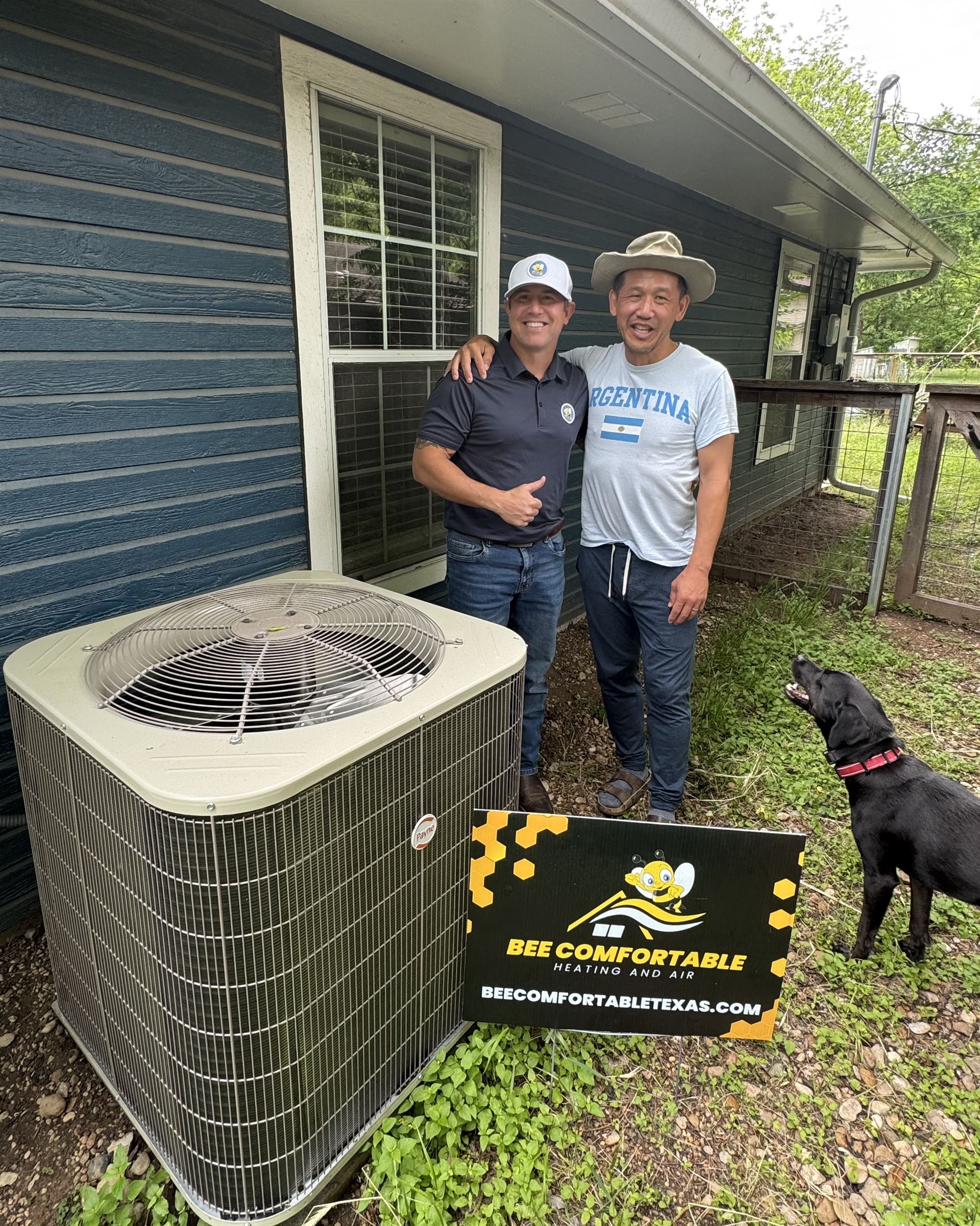
By the time July hits 100°F in Buda, TX, your air conditioner is doing more work than any other appliance in your house — usually accounting for the largest single line item on your PEC bill. That's not a guess; cooling and heating typically make up around 40–50% of a Texas home's electricity use, and in our stretch of Central Texas that number climbs higher between June and September. Good news: most of the waste is fixable, and a lot of it doesn't require spending a dime.
I've been working on systems around Buda, TX and the surrounding Hill Country since 2013, and the same handful of HVAC energy-saving tips come up over and over. Here's what actually pays off for homeowners around here.
Understand What Your AC Can (and Can't) Do
This is the one I wish every Buda, TX homeowner understood before the first 100°F day: a residential air conditioner is engineered to pull indoor air roughly 20°F below the outdoor temperature. That's a physical design limit, not a setting you can override.
When it's 102°F outside, your system is doing its job if it holds the house around 78–82°F. Cranking the thermostat down to 68°F doesn't make it colder — it just guarantees the compressor never shuts off. You burn through electricity, the unit wears out faster, and the house never reaches the target anyway.
As Brian, owner of Bee Comfortable, puts it: "I get calls every July from folks convinced their AC is broken because it won't hit 70 degrees in the afternoon. Nine times out of ten the system is working perfectly — the math just doesn't allow it. Once we explain that, the fix is usually a smarter thermostat schedule, not a new compressor."
Set the Thermostat With Buda Summers in Mind
The Department of Energy recommends 78°F as the baseline summer setting when you're home, with setbacks of 7–10°F while you're at work or asleep. Following that schedule consistently can cut cooling costs by roughly 10% per year — a real, verifiable number worth taking seriously.
A programmable or smart thermostat makes this effortless. Most newer models also learn your home's "thermal lag" — how long it takes a 1990s-era Buda, TX subdivision home with average insulation to recover from a setback — and start cooling before you walk in the door. If your thermostat is still the basic round dial from the previous owner, upgrading is one of the highest-ROI moves you can make. Smart Thermostat Installation
Take Care of the Outdoor Unit
The condenser sitting on the south or west side of your house is taking a beating right now. A few things to check this week:
- Clear two feet of space around the unit. Cedar debris, mulch piles, and overgrown lantana all choke airflow.
- Hose off the coil fins with low pressure from the top down. Pollen and dust around here build up fast.
- Check for shade — but not too close. A nearby tree that shades the unit in the afternoon can improve efficiency by up to 10%, but branches hanging directly over it drop leaves and seed pods into the fan.
- Listen for grinding or rattling. That's usually a fan motor bearing or a loose contactor, and catching it early is the difference between a $200 repair and a $2,000 one.
A condenser that's been ignored for three summers will run 15–25% less efficiently than a clean one. That's money straight out of your wallet every billing cycle.
Don't Skip the Twice-a-Year Tune-Up
I push every customer toward two professional check-ups annually — once in spring before cooling season, once in fall before the first cold snap. On a proper tune-up, we're checking refrigerant charge, measuring the temperature split across the evaporator coil, inspecting the blower motor and capacitor, tightening electrical connections, and clearing the condensate drain line.
That last one matters more than people realize. A clogged drain line in a Buda, TX attic in August will dump water through your ceiling within hours. I've patched too many sheetrock holes that started as a $15 maintenance item. HVAC Maintenance Plans
Tighten Up the House Itself
Your HVAC system can only be as efficient as the envelope it's cooling. A few upgrades worth the spend, especially for the older housing stock around Kyle, TX, Buda, TX, and Manchaca, TX:
- Double-pane low-E windows. Single-pane glass in a Texas summer is basically a radiator pointed into your living room.
- Attic insulation to R-38. Current code in our area is R-38 for ceilings, and a lot of homes built before 2010 are sitting at R-19 or worse.
- Seal the duct boots. Mastic at every register and return drops air loss dramatically — the average Texas home leaks 20–30% of its conditioned air into the attic.
- Weatherstrip exterior doors. A $12 fix that pays for itself in one month.
Consider a Heat Pump on Your Next Replacement
For most of the year, Buda, TX sits in the temperature band where modern heat pumps are dramatically more efficient than gas furnaces or electric strip heat. Our winters rarely drop below the threshold where heat pumps lose their edge, and the same equipment handles cooling all summer. If your system is pushing 12–15 years old, it's worth running the numbers on a heat pump replacement before reflexively swapping in another straight-cool condenser. Heat Pump Installation
Bee Comfortable is a licensed HVAC contractor (License #TACLB135763E) serving Buda, TX and surrounding communities since 2013.